“For Massimo, design was life and life was design,” New York–based designer Michael Bierut once said of his mentor Massimo Vignelli (1931–2014), with whom he worked early in his career. Bierut spent a decade in the 1980s under Vignelli’s watchful eye, absorbing the dos and don’ts of Swiss-centric graphic design.


“In those days,” Bierut recalled, “it seemed to me that the whole city of New York was a permanent Vignelli exhibition. To get to the office, I rode the subway with Vignelli-designed signage, passed people carrying Vignelli-designed Bloomingdale’s shopping bags, and walked by St. Peter’s Church, with its Vignelli-designed pipe organ visible through the window.”


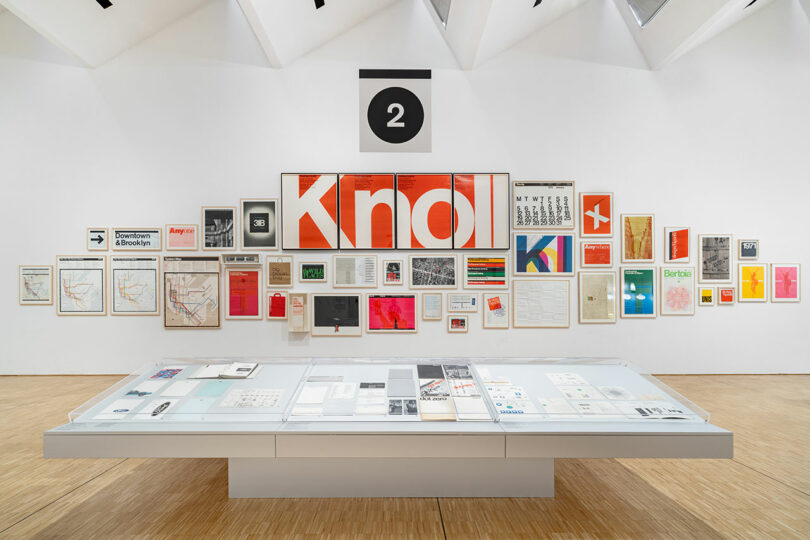
Massimo, together with his wife and lifelong collaborator Lella Vignelli (1934–2016), is now the subject of A Language of Clarity, a retrospective exhibition at Triennale Milano co-curated by Francesca Picchi, Marco Sammicheli, Martin Kerschbaumer, and Thomas Kronbichler (Studio Mut). The show celebrates the couple’s enduring legacy, emphasizing their contributions to modernism, visual culture, and multidisciplinary design. Jasper Morrison’s Office for Design, with David Saik, shaped the exhibition as a coherent system—an environment that itself reflects the Vignelli mindset. Displays of printed ephemera are meticulously arranged in cases, framed, and hung with graphic precision, presenting an all-encompassing overview of their commercial print work.


“Clarity, for the Vignellis, is not an aesthetic preference; it is an ethical and methodological position. Their work is always rooted in a logical process, grounded in essentiality and reduction,” wrote Sammicheli, Director of the Museo del Design Italiano at Triennale Milano. The exhibition is a collaboration with the Vignelli Center for Design Studies at the Rochester Institute of Technology (USA), which has preserved more than 750,000 documents, objects, and artifacts spanning book design, visual identity, corporate systems, posters, exhibitions, products, furniture, and architectural photography.


From the outset, the couple operated in near-perfect harmony. Both grew up in Italy—Massimo in Milan, and Lella, born Elena Valle, in Udine. They first met at an architecture conference in 1949, then crossed paths again in Venice while studying at the Istituto Universitario di Architettura di Venezia (IUAV), where both their personal and professional partnership began to take shape. They married in 1957 and briefly moved to Chicago, with Lella going on to study architecture at the Massachusetts Institute of Technology (MIT), before returning to Milan at the height of Italy’s postwar design renaissance. There, they built a practice that moved fluidly across disciplines—graphics, products, exhibitions, and interiors—for clients including Olivetti, Pirelli, Venini, La Rinascente, Poltrona Frau, and Xerox.


According to Picchi, the Max dinnerware was originally conceived for an Italian manufacturer of plastic figurines and toys. The Vignellis persuaded the company to produce their elegant, modular, stackable, and affordable tableware design; however, the set was never distributed. Though the project initially failed to reach the market, it was later revived through New Yorker Alan Heller and his connections to the American market. Today, it is considered a classic, having received Italy’s highest design honor, the Compasso d’Oro, in 1964.


When Massimo—co-founder and design director of Unimark International (1965–71)—was invited to lead its New York office, he and Lella relocated to the United States. There, they developed corporate identities for major clients including Ford Motor Company, Knoll, Alcoa, Bloomingdale’s, and American Airlines. In 1971, they founded Vignelli Associates, marking the beginning of a new chapter. As Sammicheli observes, “The move to New York is presented as a moment of expansion. It coincides with their rapid international recognition and with the testing of their language within a new economic and cultural system.”


Their output during this period reflects a deeply systematic approach to design—visible in typographic programs, signage systems, publications, posters, and the now-iconic New York City Subway map, all shaped by a precise graphic language. As Picchi notes, “One of the central ambitions of the exhibition is to restore visibility to Lella Vignelli, whose contribution has too often remained unjustly in the background. Lella was an architect of remarkable rigor and sensitivity.” Her work ranged from interiors for the Artemide showroom to furniture for Poltrona Frau, as well as the Handkerchief Chair for Knoll—projects that embody her enduring elegance and exactitude.


Looking back, it feels timely to reassess the Vignellis’ place in design history. While their work was at times underrecognized within the broader narrative of Italian design—particularly between the mid-1960s and 1980s—today they are understood not only as champions of Italian modernism, but as architects of a universal design language defined by discipline and a remarkable consistency that continues to resonate across generations.


Photography by Delfino Sisto Legnani of DSL studio © Triennale Milano
 FANTESTICRYAN Small Animal Statues Home Decor Modern Style Black Decorative Ornaments for Living Room, Bedroom, Office Desktop, Cabinets…BUY NOW