Berlin-based, Danish architect Sigurd Larsen always looks to counterbalance the uniformity of ever-pervasive modernism with vernacularity: the climate, history, and material culture of a specific location. For him, the relationship between the constructed environment and human experience is shaped by much more than just form and function.


“We look at how people built before modern machinery,” Larsen is quoted saying in the foreword to an upcoming monograph. This isn’t the half-hearted reverse engineering of so-called “place-making”—an ever-popular marketing term with less and less meaning.

As demonstrated in the recently completed Meraki Studios retreat in southern Crete, the architect and his team take this craft-led approach seriously. “Observing and adapting to local skills is central to our process, [as are] environmental factors like sunlight, wind direction, and views. [We always look to] maximize the quality of both exterior and interior space.”


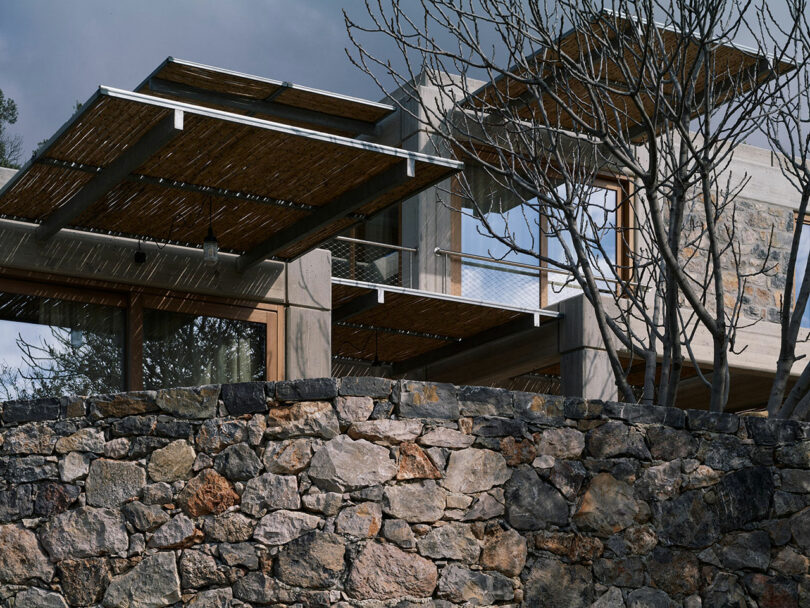
For the complex—an almost pixel-like massing of stacked cubes—the architect harnessed the stonework know-how endemic to the area. “We quickly realized that the locals excel at [this trade], but there’s little expertise in carpentry because they don’t have a wood industry,” Larsen notes. “There used to be trees all over Greece, but as early as the Stone Age they were cut down and never returned. This informed what we could work with locally.” Necessity—and adaptation—are truly the mothers of innovation.


The material fills-in the 3D-grid concrete shell of the structure, which nestles into the grade of the terraced hillside, taking on the intended appearance of a constructed rock; a geological geometry. Like with most places along the Mediterranean rim, especially thick stone walls are implemented for their thermal properties: naturally cool the spaces they enclose.


The nods to site and local tradition don’t stop there. The 40 by 16 foot infinity pool just off to the side evokes the scale and proportion of the water reservoir farmers in the area create, not to mention the natural streams that filter through the landscape in colder seasons.

The six carefully outfitted residences—for rent—aren’t hermeneutically sealed however. Carefully placed exposures make the most of surrounding vistas. Each begins as a cave carved into the earth but then extrudes outward toward the panoramas. The unified building’s idiosyncratic formation makes for additional overhangs and balconies—outfitted with pergolas—that accommodate much needed shade. These tropical and sub-tropical strategies supplement the need for environmentally harmful air conditioning.

Also imagined by Larsen and his team, the distinctly sized apartment—215 to 430 square-feet, are outfitted in a sober palette of materials reflecting the architecture: built in kitchens, bedframes, and bench-like dining tables.
The focus is, undoubtedly, outside with the seaside, not too intrepid hikes, and local markets not too far. A nearby farmer has made his grove available to guests as well.


What: Meraki Studios
Where: Crete, Greece
How much: $340
Design draws: Sigrud Larsen‘s geometric rock apartment rental nestled into southern Crete’s olive grove hills with cave-like interiors giving way to sweeping vistas and covered patios.
Photography by Kkrom Services.
 FANTESTICRYAN Small Animal Statues Home Decor Modern Style Black Decorative Ornaments for Living Room, Bedroom, Office Desktop, Cabinets…BUY NOW